

The Beekeeper
Respecting Nature’s Intelligence

There’s a village in the Lot valley in southwest France that produces some of the finest honey in the country. The locals will tell you this without much modesty. They’ll also tell you it wasn’t always that way, and that the reason it changed has everything to do with a man named Édouard Valat, who kept bees for forty years and spent most of those years getting it wrong.
Édouard inherited the hives from his father, who inherited them from his. By the time the apiary passed to him in 1987, it comprised sixty-two hives arranged along a south-facing limestone escarpment, overlooking a river and three hundred acres of wildflower meadow. On paper, it was perfect. In practice, Édouard spent the next two decades in a state of low-level war with his own bees.
He read every manual he could find. He attended conferences in Bordeaux and Lyon. He monitored temperatures, tracked foraging patterns, and adjusted hive placement with a precision that bordered on the obsessive. His honey was good, some years excellent, but the colony losses troubled him. Some winters he’d lose a quarter of his hives. He blamed disease, weather, pesticides drifting from neighbouring farms. He was right about all of those things, and none of them were the real problem.
The real problem was that Édouard could not leave well enough alone.
He opened his hives too often. He rearranged frames when the bees were mid-cycle. Each intervention came from a place of genuine care — but the bees read it differently.
He supplemented feed when the colonies didn’t need it. He installed new queens into hives that were already stable. Each intervention came from a place of genuine care, of wanting things to go well, but the bees read it differently. To them, every intrusion was a disruption. Every disruption demanded energy to recover from. The colonies were spending themselves not on honey, not on growth, but on the constant work of stabilising after each of Édouard’s well-meaning adjustments.
A veteran beekeeper from the Dordogne visited one summer and watched Édouard work for an afternoon without saying anything. Then, over wine, he said something that Édouard dismissed at the time and thought about for years afterward.
“Your bees know what to do,” the man said. “They’ve known for forty million years. Every time you open that lid, you’re telling them you don’t believe it.”
Édouard laughed it off. He was a practical man, trained in practical methods. The idea that his presence was the disruption, not the cure, felt like mysticism. He went home and ordered a new thermometer.
~ The most expensive thing he owned wasn’t a hive. It was his certainty. ~
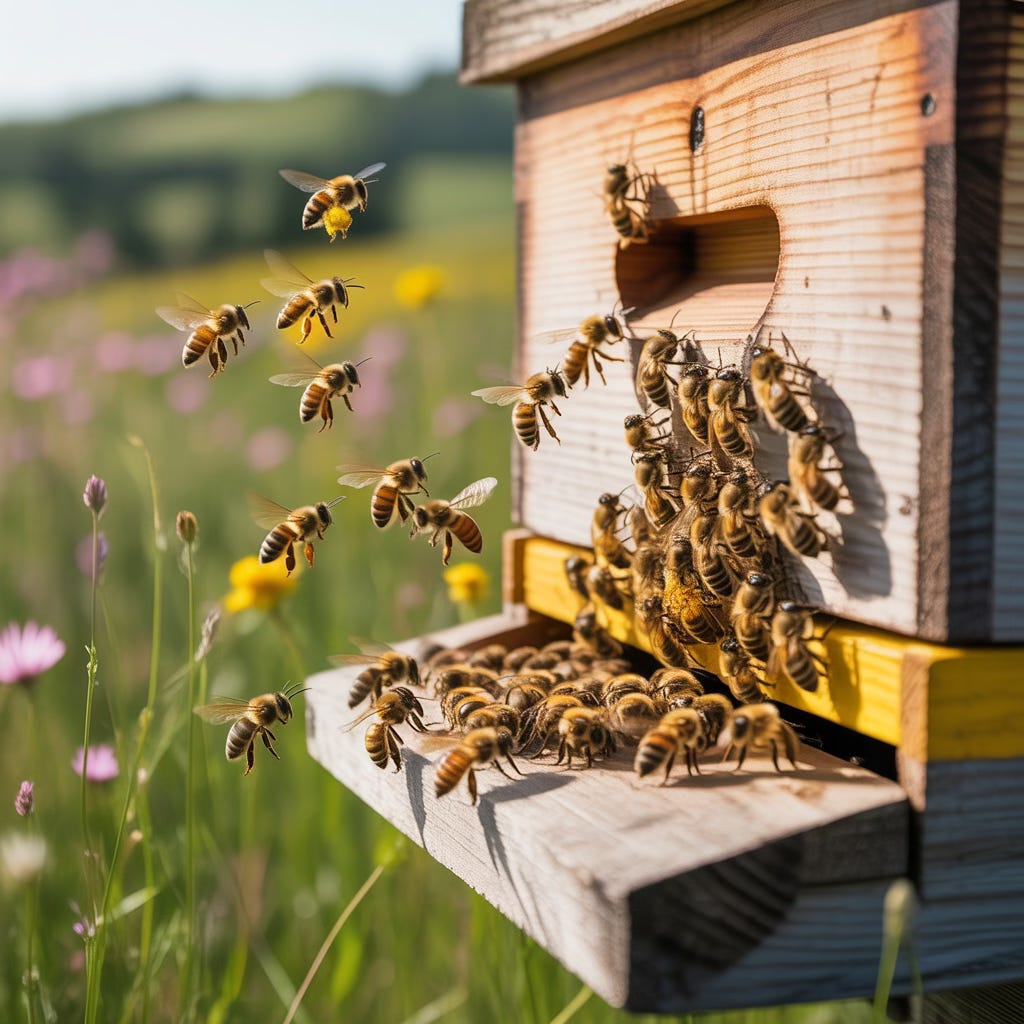
But the losses continued. In the winter of 2003 he lost nineteen hives in three months. He sat with that number for a long time. Nineteen hives. Three decades of accumulated knowledge, and nineteen hives gone. Something in him that had always argued against the old beekeeper’s words went quiet that winter. It didn’t surrender dramatically. It just... went quiet.
The following spring, Édouard changed almost nothing about his setup and everything about his approach.
He stopped opening hives on schedule and started opening them only when there was a specific reason. He stopped adjusting frames unless something was structurally wrong. He moved from weekly inspections to fortnightly ones, then monthly, then to a system of observation that relied mostly on watching the entrance activity, the temperature readings from external sensors, the weight of the hives via simple platform scales. He learned to read his bees from the outside. What he discovered was that the outside told him almost everything the inside had been telling him, without the cost.
He stood at a distance from hives he wanted to open and watched himself want to open them.
That first summer was uncomfortable. There’s a particular kind of restlessness that comes from having a problem and choosing not to immediately act on it, and Édouard felt it acutely. He’d convinced himself over the years that doing something was always better than doing nothing, that watchfulness without intervention was just neglect dressed up as philosophy. Unlearning that took longer than any practical skill.
What he noticed, slowly, was this: the bees were fine. Better than fine. When he did open hives, he found brood patterns of unusual regularity, honey stores built with a consistency he hadn’t seen in years, populations that seemed settled and purposeful rather than perpetually reactive. The colonies had a quality he struggled to name at first. Eventually he settled on the word momentum. They had their own momentum, and he hadn’t been allowing it.
By 2006 his colony loss rate had dropped to under four percent. By 2010, the Valat apiary had expanded to over a hundred hives, and his honey had won three regional awards. Journalists came occasionally to write about his methods. He was always careful about how he described them, because he didn’t want to suggest he’d stopped caring or stopped paying attention. The attention had actually intensified. It had simply changed in character.
~ “I watch more now than I ever did. I just touch less.” ~
This is a story about discernment. Édouard still treated disease when it appeared. He still monitored for mites, still managed swarms, still made the interventions that genuinely needed making. The practice was about learning to distinguish between the actions that helped and the actions that were really just a way of managing his own discomfort. Most of his earlier interventions, he eventually admitted, had been the second kind. He’d been opening those lids to feel useful. To feel in control. To have something to show for his presence. The bees had been paying for his need to feel like a good beekeeper.
Most of us do a version of what Édouard did. We intervene in our relationships before the silence has finished speaking. We adjust and revise on a schedule that has more to do with our anxiety than with any real signal from the situation itself.
There’s something in this worth sitting with, because most of us do a version of what Édouard did. We intervene in our relationships before the silence has finished speaking. We second-guess our work before the work has had a chance to find its shape. We adjust and revise and course-correct on a schedule that has more to do with our anxiety than with any real signal from the situation itself. We call this conscientiousness. We call it high standards. Sometimes it is those things. Often it’s just fear with a work ethic.
The shift Édouard made was from a caring that expressed itself through constant management to a caring that expressed itself through trust. And trust, in practice, looks a lot like stillness. It looks like watching. It looks like resisting the urge to open the lid just because you haven’t opened it in a while.
The honey that comes from his hives now has a depth that visitors always remark on. Édouard says it’s the wildflowers, the limestone soil, the particular quality of light in that valley. All of that is true. But there’s something else in it. You can taste the fact that nobody interfered. You can taste the forty million years of knowing, left to do what it knows.
~ You can taste the forty million years of knowing, left to do what it knows. ~
He retired from beekeeping in 2021 at seventy-three, and handed the apiary to his daughter, Camille, who had watched him change over the years and understood what she was inheriting. Not just the hives. The approach.
On her first day managing the apiary alone, she stood at the edge of the escarpment for a long time, watching the entrance boards, the drift of bees against the afternoon light. Her hands stayed in her pockets.
She didn’t open a single hive.
Later, asked what she’d learned from watching her father, she said: “He used to say that the hardest thing he ever did was learn to trust what he couldn’t see. But once he did, everything he could see got better.”
That’s what forty years and nineteen lost hives purchased for Édouard Valat. A different relationship to the intelligence already present in things. An understanding that the most powerful thing you can sometimes offer, to bees, to people, to your own unfinished work, isn’t your next move. It’s your willingness to wait and see what move the situation is already making.
The valley still produces some of the finest honey in France.
Nobody’s quite sure why.
Édouard knows, but he tends not to explain it. He’ll pour you a glass of wine and let the honey speak for itself.
~
I hope this reached you, Leo